
What if a festival date looks confirmed only because the same old listing appears in several search results? Repetition isn’t proof. To learn how to find verified festival dates, follow the source trail to an official festival, organizer, venue, or artist channel, and check when the information was published.
It’s reasonable to be cautious. A festival page may announce an event without posting its schedule, and dates can change after older listings have spread. A directory can help you find events and their sources, but the organizer remains the final check.
This guide gives you a repeatable way to confirm a date, assess whether a schedule is provisional or outdated, and handle conflicting information. You’ll learn which sources carry more weight, what red flags to watch for, and when to check again before making plans. No detective board required, but checking the original announcement beats trusting a copied date.
Key Takeaways
- Learn how to find verified festival dates by tracing a listing to a credible source that names the event and year.
- Check the organizer’s current website or official announcement first. Use government pages or newspaper reports as supporting sources.
- Watch for warning signs such as missing years, broken links, and details copied from past editions.
- Use a repeatable checklist to compare the event name, year, exact dates, source, and available update information.
- Browse USA Fest Bot by state, date, or category to discover 2026 events, then cross-check details with the organizer.
How to Find Verified Festival Dates: What ‘Confirmed’ Actually Means
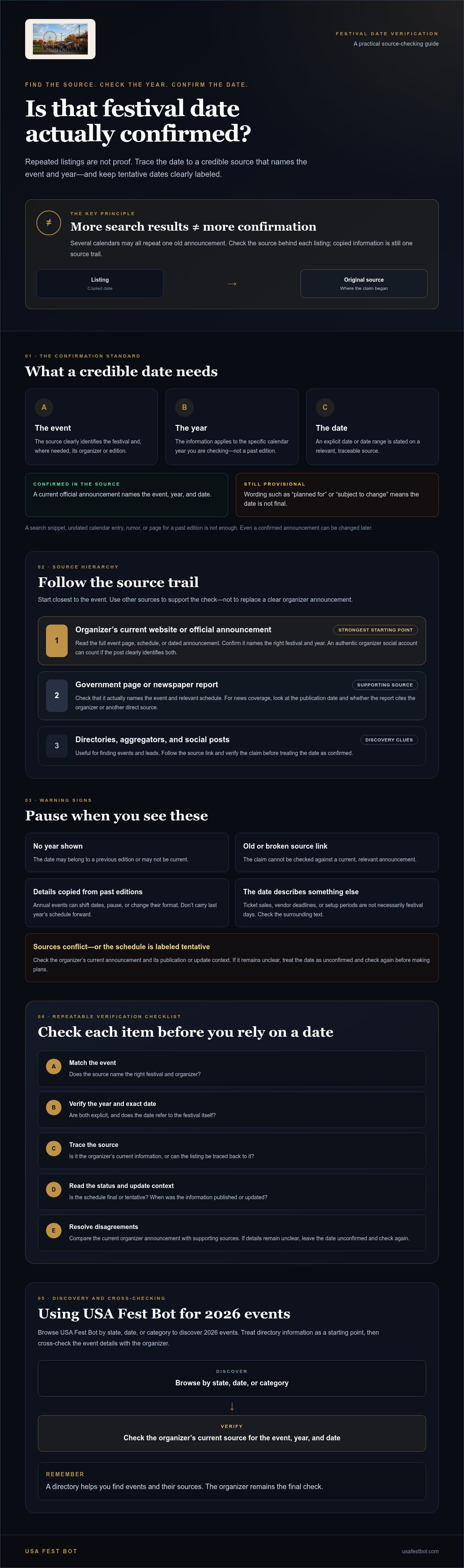
To understand how to find verified festival dates, start with a clear standard: the date must be traceable to a credible source that identifies both the event and the year. A search result snippet, an undated calendar entry, or a page for a past edition isn’t enough. The source trail matters more than how often a date is repeated.
A date needs a traceable source naming the event and year. That’s the basic rule. Next, check whether the source presents the date as final or tentative. An organizer’s announcement that says “planned for” or “dates are subject to change” is useful, but it’s provisional. A social post without a clear connection to the organizer is a lead to investigate, not confirmation. A rumor remains a rumor, even if it has been reposted widely.
What counts as a confirmed festival date?
Look for the festival’s name, the specific year, and an explicit date on a relevant source. An organizer’s current website or official announcement is the strongest starting point. A government page or newspaper report can support your check, especially when the organizer’s information is difficult to find. These information literacy skills help you assess who published a claim and whether the source actually supports it.
Don’t carry last year’s schedule forward. Annual events may shift dates, pause, or change their format. A page showing a past edition can establish that the festival took place before, but it doesn’t confirm this year’s schedule. If an announcement labels dates as tentative, keep that label attached when sharing or recording them. Don’t quietly upgrade “planned” to “confirmed.”
Why dates can differ between listings
Secondary calendars and event pages may copy details from an organizer, then continue displaying them after the original schedule changes. Several matching listings can all trace back to the same outdated information. Check the source behind each date, not just how many pages repeat it.
Also confirm what each date describes. A ticket-sale date, vendor application deadline, or setup period isn’t necessarily an event day. One listing might show a festival’s opening date while another gives its full run. Read the surrounding text and compare the exact date range and event name.
If sources disagree, don’t choose the most convenient date or assume the newest-looking page is right. Open the organizer’s current announcement, check its publication or update context, and see whether it addresses the conflict. If the schedule is still unclear, treat the date as unconfirmed and check again before booking travel or making purchase plans. Confirmation describes what a credible source says now. It can’t rule out a later change.
Which Sources Can Confirm a Festival Date?
Use a source hierarchy. Start with the event organizer’s current website or official announcement. If that doesn’t provide a date, look for supporting information from a government page or newspaper. Aggregators and social posts can help you find a lead, but trace the claim to its source before treating it as confirmed.
Source rule: Corroboration helps, but copied listings are not independent confirmation. If several calendars repeat the same date from one old announcement, they’re still part of one source trail, not several separate checks. This distinction is central to how to find verified festival dates without mistaking repetition for evidence.
Start with the organizer’s own announcement
Open the organizer’s current event page, schedule, or dated announcement. Check that it names the festival and the right calendar year. Similar event names can refer to different organizations or editions, so confirm the organizer’s identity too. Read the full announcement, not only a search snippet or social preview.
If the official page is silent about this year’s dates, don’t infer them from last year’s schedule or an annual pattern. Mark the date as unconfirmed until a relevant source publishes it. A social post can count as an official announcement when it comes from the organizer’s genuine account and clearly identifies the event and year.
Use government and newspaper sources carefully
A government page can support a date when it clearly identifies the event and gives the relevant schedule. For example, a public notice page is useful only if it actually names the event and date you’re checking. A government domain alone doesn’t confirm a festival schedule.
Newspaper coverage can also help, especially when the organizer’s page is unavailable. Check the publication date and whether the report cites the organizer or another direct source. A dated report explaining where the schedule came from offers more context than an undated calendar mention. If the report covers an earlier edition, it doesn’t verify a later year.
Use event aggregators and social posts as discovery clues. Follow their source links, compare the year and dates, and look for a current organizer announcement. If the source trail ends at a copied listing, keep the status unconfirmed. A directory such as USA Fest Bot’s U.S. event listings can help you find events by state, date, or category, then continue to the source before making plans. The directory is a cross-checking aid, not a substitute for the organizer’s latest information.
How to Spot Outdated, Conflicting, or Unverified Festival Dates
A date can look current because it appears on several sites, yet still come from one old listing copied around the web. Check the trail behind each claim. Compare the source, its publication or update date, the event year, and the organizer’s identity. If one of those details is missing, the date may need more checking.
Warning signs in a festival listing
Look for clues that the listing may not refer to the edition you plan to attend:
- No year shown: A date such as “October 12 and 13” doesn’t identify which edition it describes.
- Past-edition details: The page refers to a previous year, old performers, or an expired schedule without linking to a current announcement.
- Broken or inactive source: The organizer’s page no longer loads, or its social account has no current event details. This doesn’t prove the date is false, but it leaves the claim unverified.
- Conflicting dates: Listings give different schedules, and none points to a credible source that resolves the difference.
Don’t call an announcement fake based on a broken link or outdated date alone. Describe what you can establish: the date is unconfirmed, the source is unavailable, or the details conflict. That’s more accurate than guessing at someone’s intent.
How to compare conflicting dates
Record each claim separately. Note the event name, year, date shown, source, publication or update date, and whether the source is connected to the organizer. Then check whether each listing has its own evidence or simply repeats another page. Five copies of one claim still make one source trail.
| Status | What the check shows |
|---|---|
| Confirmed | A current, credible source names the event and year and states the date. |
| Changed | A credible, newer source updates or replaces an earlier date. |
| Tentative | The organizer shares a possible date but identifies it as provisional. |
| Unable to verify | The year, source, organizer, or current schedule can’t be established. |
When sources disagree, give more weight to a current organizer announcement than to an undated calendar entry. But don’t assume a page is newer just because it appears higher in search results. To find verified festival dates, keep the evidence and status together, then check the organizer again before making travel or purchase plans.
A Step-by-Step Festival Date Verification Checklist
Use this process for any festival or fair. Keep a short record of what you checked. It makes the date easier to verify again if plans change or a listing gets updated.
Follow these checks before making plans
- Find the organizer’s source. Open the current event page or official announcement. Confirm it names the right festival and organizer.
- Check the year and exact dates. Record the full date range, including the year. Don’t fill in missing details from an older edition.
- Note the source and its update evidence. Save the page address and record any publication or update date shown. Also note when you checked it. If no update date is visible, write that down rather than assuming the page is current.
- Compare a supporting source. When available, check a relevant government page or newspaper report. Confirm it refers to the same event and year, and see whether it cites the organizer.
- Check again before departure. A confirmed schedule can still change. Revisit the organizer’s source close to your trip, especially before committing to travel or purchase plans.
A simple note can capture the essentials: event name, year, exact date, source, source publication or update evidence, and the date you checked. This record gives you a clear basis for deciding whether the information still holds up.
What to do when no date is confirmed
Don’t infer a date from last year’s schedule or because the festival usually happens in the same season. Check the organizer’s website and official announcement channels again. If the information is still unclear, contact the organizer directly and ask: “Are the dates for [event name] in [year] confirmed, and what are the exact event dates?” That wording separates the event schedule from ticket-sale dates, application deadlines, or setup days.
Until a credible source confirms the date, mark it as unconfirmed and keep travel plans flexible. A directory can help you find events and follow their source trail, but the organizer remains the place to check for current details. Use this checklist each time you’re working out how to find verified festival dates, then browse 2026 U.S. event listings to find festivals and fairs to cross-check.
Use USA Fest Bot to Find and Cross-Check 2026 Festival Dates
USA Fest Bot is a searchable directory of U.S. fairs, festivals, parades, rodeos, and holiday events for 2026. Use it to find events by state, date, or category. It can narrow your search, but a directory listing can’t rule out a schedule change. Confirm the details with the event organizer before making plans.
Find a listing, then check its source
Start with the type of event or time period you’re looking for. Browse by category if you know the event type, by date if your plans are tied to a particular time, or by state to narrow a nationwide search. When you find a listing, check its event name and year, then use its source information to find the underlying announcement.
USA Fest Bot reports dates confirmed through official organizer sites, government pages, or newspaper sources. Treat that as a useful starting point for verification, not a substitute for the original source. Check that the source refers to the same event and edition, and look for any later schedule changes. If you can’t establish which source supports the date, consider it unverified until you can confirm it directly.
Recheck the organizer’s current information before departure and before ticket-related decisions. A date that was accurate when announced may change. For questions about event dates, schedules, or tickets, contact the organizer. USA Fest Bot doesn’t sell tickets and directs visitors to event organizers.
Choose a clear next step
Pick the browsing route that fits what you already know:
- Know the event type? Browse by category to find relevant fairs and festivals.
- Have a date in mind? Browse by date, then verify the event’s full schedule with its organizer.
- Searching across the country? Browse by state to focus your results, then check each event’s source trail.
Use the directory to discover candidates, then confirm the date with the organizer before you commit. You can also browse USA Fest Bot’s 2026 event listings and follow each promising lead to its source.
Make Your 2026 Festival Plans With a Clear Source Trail
The reliable way to confirm a festival date is to check a source that names the event and year, then compare conflicting details before you make plans. Keep tentative dates labeled as tentative, and check the organizer’s information again before departure. A little source-checking now can help you avoid planning around an old schedule.
USA Fest Bot can help you discover 2026 fairs and festivals by state, date, or category. Its listings draw on official organizer sites, government pages, or newspaper sources, but schedules can still change. Use the directory to find an event, then follow the source trail and confirm current details with the organizer. USA Fest Bot doesn’t sell tickets, so direct ticket questions to the event organizer.
Ready to put how to find verified festival dates into practice? Browse verified 2026 event listings, then confirm the details with the source. Your plans can start with a better-informed date.
Frequently Asked Questions
How can I tell if a festival date is officially confirmed?
To find verified festival dates, look for a credible, current source that names the event, calendar year, and exact date. Start with the organizer’s event page or dated announcement. Confirm it refers to the edition you plan to attend, not a past schedule or tentative notice. If the organizer hasn’t published the date for that year, don’t infer it from an annual pattern. Treat it as unconfirmed until a reliable source provides the details.
Is a festival date on an event directory guaranteed to be current?
No directory listing can rule out a later schedule change. Check what source supports the date, then follow it to the organizer’s current announcement when possible. USA Fest Bot reports dates confirmed through official organizer sites, government pages, or newspaper sources, but readers should still recheck the organizer before making plans. A listing is a useful discovery and cross-checking aid, not a guarantee that the schedule will remain unchanged.
Can I trust a festival date posted on social media?
Trust it as confirmation only if it comes from the festival organizer’s genuine account and clearly names the event, year, and date. Check the account’s profile and links to establish that it belongs to the organizer. A repost, fan page, or event discussion can point you toward a source, but it doesn’t confirm the schedule by itself. Follow the claim to the organizer’s own announcement before relying on it.
What should I do if two websites list different festival dates?
Compare the event name, year, and exact dates on both pages. Then check each page’s publication or update information and follow its source links. Give more weight to a current organizer announcement than to an undated calendar listing. See whether either source explains a change or cites the organizer directly. If the conflict remains unresolved, contact the organizer and treat the date as unconfirmed until clarified.
How do I find a festival’s official website or organizer?
Search the festival’s full name with its year and terms such as “official website” or “organizer.” Compare results with the event’s venue, known partners, or government and newspaper references. Look for consistent event details and links between the organizer’s site and its official announcement channels. If results point to several similarly named events, verify the organizer’s identity before relying on a date or sharing personal or payment information.
How often should I recheck a confirmed festival date?
There’s no fixed recheck interval that applies to every festival. Check the organizer’s current information before making travel or ticket-related plans, then check again before departure. Revisit the source if you see a conflicting listing, a change notice, or an announcement marked tentative. Record when you last checked and whether the organizer showed an update date. A confirmed schedule reflects available information at that time, not a promise that it cannot change.
Does USA Fest Bot sell festival tickets?
No. USA Fest Bot is a searchable directory for U.S. fairs, festivals, parades, rodeos, and holiday events, and it does not sell tickets. It directs visitors to official event organizers for more information. Use a listing to discover an event and follow its source information to check current details. For ticket availability, purchasing, refunds, or event-specific questions, contact the organizer through its official channels.

